
Blue Carbon – The importance of coastal ecosystems in climate change
Article written by Venetia Galanaki.
What is the first thought that springs to mind when thinking about ecosystems that contribute in reducing CO2? Most probably forests and grasslands right? But what about all the plants that reside on the coasts? Like mangroves, saltmarshes and seagrass meadows.
These ecosystems are present in coastal and shallow waters all over the globe but their significance in CO2 absorption has only recently started being recognised. The increased research attention gave rise to the term ‘’Blue Carbon’’ referring to carbon stored in their tissues and sediment. Blue carbon ecosystems, similarly to other vegetated ecosystems, remove CO2 from the water column through photosynthesis leading to a decrease in its total concentration. This decrease creates a disequilibrium in its concentration between the air and the water, thus driving additional CO2 in the water and removing it from the atmosphere.
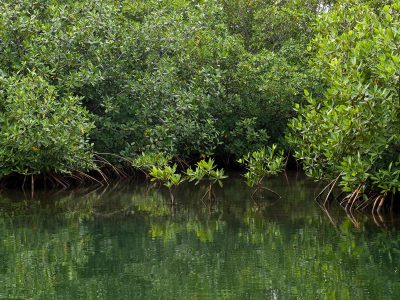

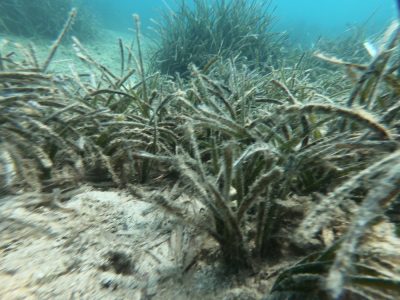
Blue carbon ecosystems store carbon in two distinct pools, their plant tissues and the sediment with the latter being the largest. Carbon rich sediment forms as a result of the accumulation of dead plant biomass and can be preserved over millennial timescales. The tissues of coastal plants are particularly resistant to bacterial decomposition due to the low concentration of oxygen in the soil, preventing the release of the carbon they have stored during their lifetime. In addition to locally produced carbon, mangroves and seagrass meadows have the ability to trap carbon floating around in the water, through slowing down water flow and promoting sedimentation of its particles.
Coastal ecosystems are capable of storing significantly larger amounts of carbon per unit area than their terrestrial counterparts. On average, they have been found to store even up to four times higher quantities of carbon. This remarkable ability arises due to their high photosynthetic rates, which allow for increased CO2 absorption from the water, and their extraordinary capacity to lock carbon in their soil creating large sediment carbon stocks
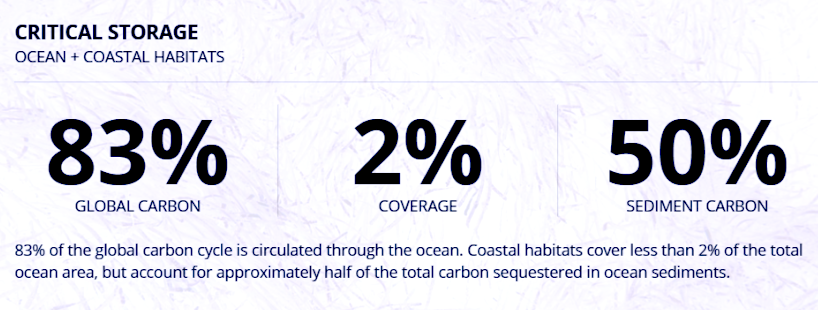
In addition to their function as carbon sinks, coastal ecosystems provide a range of services necessary for climate change adaptation such as protection from sea level rise and storm surges. Major conservation initiatives, such as the Blue Carbon Initiative, have promoted the efforts to conserve these ecosystems but they continue to degrade at alarming rates. Over the last few decades, mangroves, saltmarshes and seagrass meadows have been declining at an average rate of 100 square kilometres per year, establishing them as some of the most threatened ecosystems on the planet. Inadequate mapping, mainly of seagrass, poses an additional challenge to estimating losses as the original extent cover remains unknown.
Anthropogenic factors relating to increased coastal development are the main reasons behind their degradation. Naturally, the health of these ecosystems majorly influences their carbon trapping ability. Once the plants are destroyed or removed, their sediment becomes exposed releasing several years worth of trapped carbon back into the water, contributing to the increase of greenhouse gases. Studying Blue Carbon is highly important in fully understanding the role of the oceans in the carbon cycle. Also, increased research attention is crucial in attracting restoration funds and strengthening protection measures.
Currently, numerous restoration initiatives are taking place yet no greenhouse gas reduction schemes involving these ecosystems have been developed. The creation of such schemes as well as the inclusion of blue carbon ecosystems in the carbon market could provide powerful incentives for their protection. Given the current levels of CO2 in the atmosphere, it is critically important that these ecosystems are more rigorously protected and restored so they can continue to provide their much needed benefits for people and wildlife.


About the author: Venetia comes from Greece and the Mediterranean sea has always been her happy place. A Biomedical scientist turned conservationist, whose love for the ocean led her to pursue a career in protecting it. Over the years, she has conducted fieldwork in a variety of fields, including dolphin bioacoustics, marine pollution and seagrass carbon. She currently works in Marine Protected Area planning and management in Greece.
Image credit: Venetia Galanaki, WWF, Joseph Smith, The Blue Carbon Initiative, Anna Schleimer

Related Posts