• Sign in

  • Join for free
  • Home
  • News
  • About
    • The ODYSSEA Team
    • Sponsors
    • Collaborators
  • Projects
    • Events
    • Past Projects
    • Research and Conservation
  • Support Us
  • Publications
  • Photos
  • Contact
ODYSSEA

Search

    • en
  • info@odyssea.lu
0
ODYSSEA
  • Menu
  • Home
  • News
  • About
    • The ODYSSEA Team
    • Sponsors
    • Collaborators
  • Projects
    • Events
    • Past Projects
    • Research and Conservation
  • Support Us
  • Publications
  • Photos
  • Contact

Tag : mangrove

Home » Tagged "mangrove"
  • Coastal_Threats
    09February

    Coastal ecosystems – Threats and challenges

    Article written by Venetia Galanaki.

    Mangrove forests, seagrass meadows and saltmarshes, collectively referred to as coastal ecosystems, are some of the most valuable habitats on the planet, yet they are being lost at alarming rates. With approximately half of the Earth’s population residing on the coastal zone, anthropogenic (meaning caused by humans) pressure on these ecosystems is much higher compared to more remote habitats. On a global scale, the annual rate of decline has been estimated to be 1–3% for mangroves, 2–5% for seagrass meadows, 1–2% for saltmarshes. If this trend continues at the same rate over the next 50 years, only 15% of area covered by coastal ecosystems will remain compared to the coverage at the end of World War II. Estimating loss is a tricky business as historical data are limited and more often than not highly inaccurate. However, what is worrisome is that the rates at which we are losing these important ecosystems seem to be accelerating despite the recognition of their invaluable ecosystem services.

    (Image credit: Duarte et al., 2008)
    (Image credit: Duarte et al., 2008)

    Numerous and often interconnected factors have led to this decline. 

    • Coastal development and Tourism: construction of pipelines, structuring of ports and deployment of cables for communication, has made the complete removal of these ecosystems common practice. Infrastructure built to accommodate the rapid increase of the tourism industry is leaving no room for these ecosystems. In addition, tourism related activities such as anchoring over seagrass meadows and the mere overcrowding in coastal areas is intensifying the pressure. Mangroves also suffer from overharvesting as their wood has a number of uses.
    • Land runoff and Pollution: Due to their close proximity to agricultural land, coastal plants are threatened by land large amounts of fertilisers and pesticides that end up in the water and can ultimately cause their death. The damage caused by runoff is further intensified In river estuaries where water is carried from large stretches of agricultural land. Additionally, specifically for seagrass meadows untreated sewage waste and aquaculture can be really harmful due to the load of organic matter in the water.
    • Invasive species also majorly impact these ecosystems as they can alter food webs and destabilise the entire ecosystem. 
    • Climate change related phenomena, primarily sea level rise, majorly affects the long term health of these ecosystems. Mangroves are damaged by excessive water in their roots and destabilisation of their sediment. In seagrass meadows, rising sea levels prevent the necessary light needed for healthy seagrass growth. Saltmarshes are usually constrained by human made structures and so sea level rise forces their area cover to decrease in a process known as coastal squeeze. Mangrove health is also intricately connected with coral reefs as they shelter them from strong currents. Reefs, being further offshore, constitute the first barrier for strong currents and waves and so when they are damaged, mangroves are more susceptible to them.

    The vast majority of threats occur on a local level and can be minimised through efficient coastal planning and management. Eliminating local threats and, thus allowing ecosystems to be healthier, can help build resilience against the more widespread effects of climate change. Sadly, the destruction of these ecosystems is often “justified” as a means to generate profit. However, such decision-making neglects the fact that the mere existence of coastal ecosystems greatly contributes to the economy through the ecosystem benefits that they provide, such as protection from storm surges and sea level rise and support of local livelihoods. In recent years, the efforts to conserve our coasts have intensified and the laws and regulations protecting them have strengthened. Yet, until bold commitments are made they will continue to decline at the rates we see today, leaving humans and wildlife at a loss.

    About the author: Venetia comes from Greece and the Mediterranean sea has always been her happy place. A Biomedical scientist turned conservationist, whose love for the ocean led her to pursue a career in protecting it. Over the years, she has conducted fieldwork in a variety of fields, including dolphin bioacoustics, marine pollution and seagrass carbon. She currently works in Marine Protected Area planning and management in Greece.

    Reference: Duarte, C.M., Dennison, W.C., Orth, R.J. and Carruthers, T.J., 2008. The charisma of coastal ecosystems: addressing the imbalance. Estuaries and coasts, 31(2), pp.233-238. Full article here.

  • Mangrove_Malapascua
    07January

    Blue Carbon – The importance of coastal ecosystems in climate change

    Article written by Venetia Galanaki.

    What is the first thought that springs to mind when thinking about ecosystems that contribute in reducing CO2? Most probably forests and grasslands right? But what about all the plants that reside on the coasts? Like mangroves, saltmarshes and seagrass meadows.

    These ecosystems are present in coastal and shallow waters all over the globe but their significance in  CO2 absorption has only recently started being recognised. The increased research attention gave rise to the term ‘’Blue Carbon’’ referring to  carbon stored in their tissues and sediment. Blue carbon ecosystems, similarly to other vegetated ecosystems, remove CO2 from the water column through photosynthesis leading to a decrease in its total concentration. This decrease creates a disequilibrium in  its concentration between the air and the water, thus driving additional CO2 in the water and removing it  from the atmosphere.

    (c) Antonio Busiello | WWF-US
    pond-feeding-aggregation
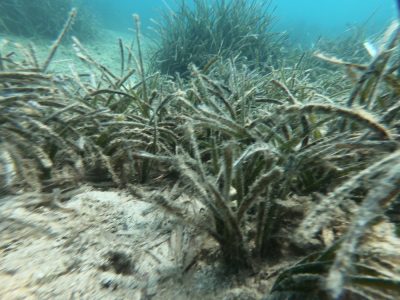
    Sea grass

    Blue carbon ecosystems store carbon in two distinct pools, their plant tissues and the sediment with the latter being the largest. Carbon rich sediment forms as a result of the accumulation of dead plant biomass and can be preserved over millennial timescales. The tissues of coastal plants are particularly resistant to bacterial decomposition due to the low concentration of oxygen in the soil, preventing the release of the carbon they have stored during their lifetime. In addition to locally produced carbon, mangroves and seagrass meadows have the ability to trap carbon floating around in the water, through slowing down water flow and promoting sedimentation of its particles.

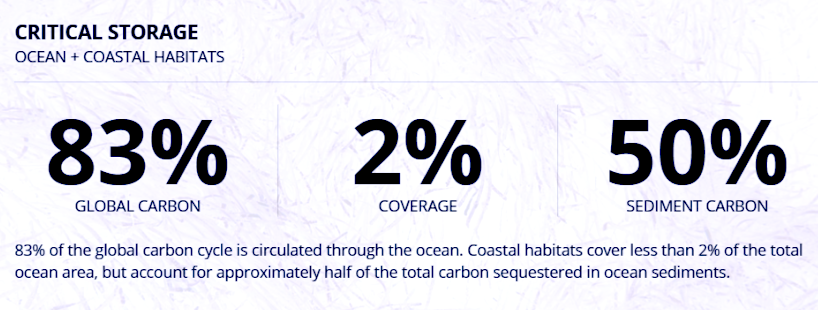
    Coastal ecosystems are capable of storing significantly larger amounts of carbon per unit area than their terrestrial counterparts. On average, they have been found to store even up to four times higher quantities of carbon. This remarkable ability arises due to their high photosynthetic rates, which allow for increased  CO2  absorption from the water, and their extraordinary capacity to lock carbon in their soil creating  large sediment carbon stocks

    blue_carbon_critical_storage

    In addition to their function as carbon sinks, coastal ecosystems provide a range of services necessary for climate change adaptation such as protection from sea level rise and storm surges. Major conservation initiatives, such as the Blue Carbon Initiative, have promoted the efforts to conserve these ecosystems but they continue to degrade at alarming rates. Over the last few decades, mangroves, saltmarshes and seagrass meadows have been declining at an average rate of 100 square kilometres per year, establishing them as some of the most threatened ecosystems on the planet. Inadequate mapping, mainly of seagrass, poses an additional challenge to estimating losses as the original extent cover remains unknown.

    Anthropogenic factors relating to increased coastal development are the main reasons behind their degradation. Naturally, the health of these ecosystems majorly influences their carbon trapping ability. Once the plants are destroyed or removed, their sediment becomes exposed releasing several years worth of trapped carbon back into the water, contributing to the increase of greenhouse gases. Studying Blue Carbon is highly important in fully understanding the role of the oceans in the carbon cycle. Also, increased research attention is crucial in attracting restoration funds and strengthening protection measures.

    Currently, numerous restoration initiatives are taking place yet no greenhouse gas reduction schemes involving these ecosystems have been developed. The creation of such schemes as well as the inclusion of blue carbon ecosystems in the carbon market could provide powerful incentives for their protection.  Given the current levels of CO2 in the atmosphere, it is critically important that these ecosystems are more rigorously protected and restored so they can continue to provide their much needed benefits for people and wildlife.

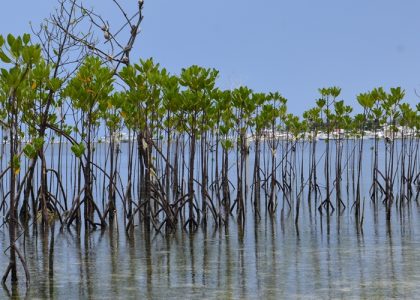
    Malapascua Island, Philippines. (c) Anna Schleimer
    greenturtle_Philippines2
    Mangroves_HongKong

    About the author: Venetia comes from Greece and the Mediterranean sea has always been her happy place. A Biomedical scientist turned conservationist, whose love for the ocean led her to pursue a career in protecting it. Over the years, she has conducted fieldwork in a variety of fields, including dolphin bioacoustics, marine pollution and seagrass carbon. She currently works in Marine Protected Area planning and management in Greece.

    Image credit: Venetia Galanaki, WWF, Joseph Smith, The Blue Carbon Initiative, Anna Schleimer

© 2026 ODYSSEA ASBL
  • Home
  • About
  • News
  • Contact